



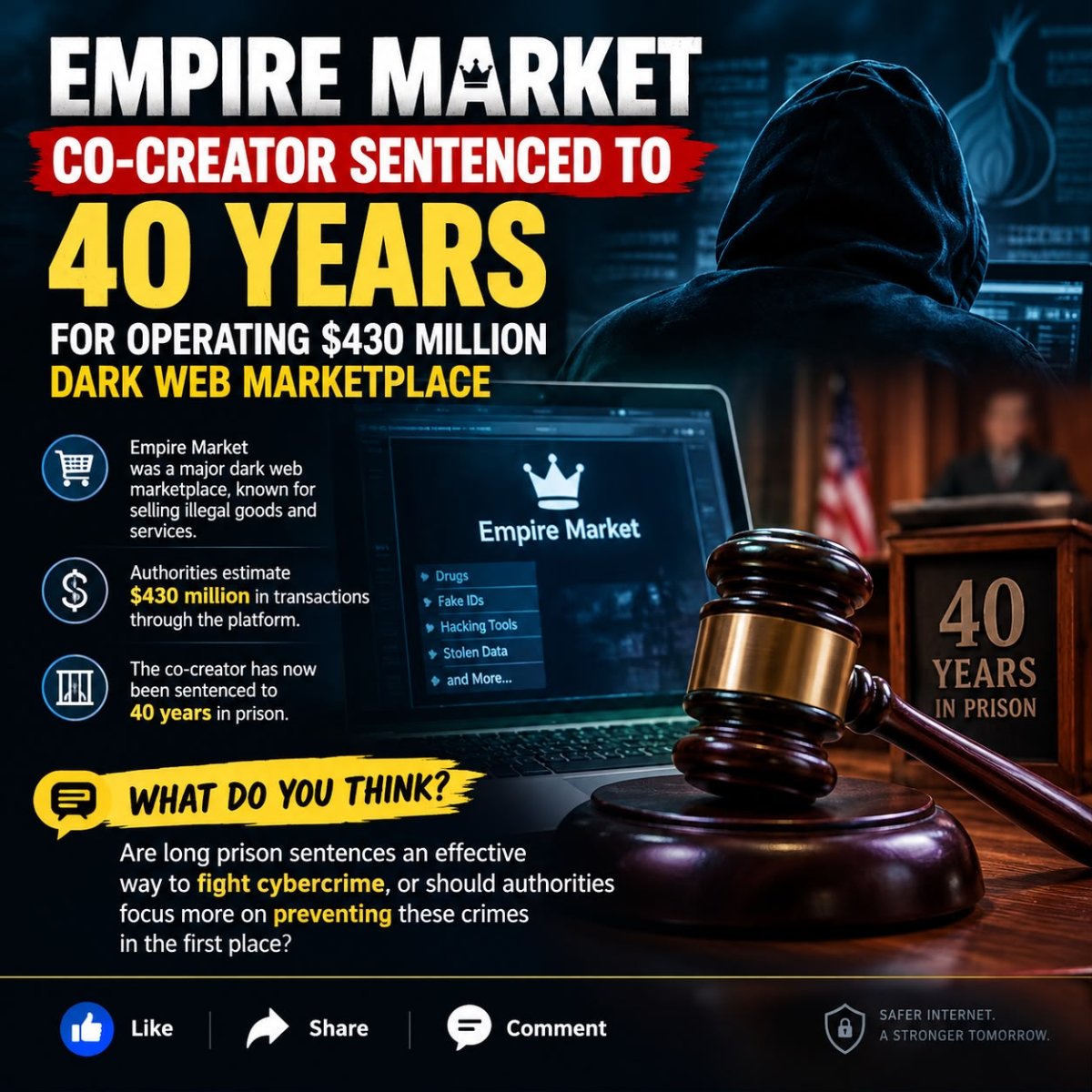
Empire Market Co-Founder Sentenced to 40 Years in Prison Over $430 Million Dark Web Operation
Raheim Hamilton, co-founder of the dark web marketplace Empire Market, has been sentenced to 40 years in federal prison and fined $5 million for his role in operating a platform that facilitated more than $430 million in illegal transactions.
The sentence marks a significant development in the US government’s efforts to combat online drug trafficking, cryptocurrency-related money laundering, and cybercrime conducted through hidden online marketplaces.
According to the US Department of Justice (DOJ), Hamilton co-owned and operated Empire Market alongside Thomas Pavey between 2018 and 2020. During that period, the marketplace facilitated more than four million transactions involving illegal goods and services.
Raheim Hamilton Receives 40-Year Federal Prison Sentence
Hamilton, 30, from Suffolk, Virginia, pleaded guilty earlier in 2026 to a federal drug conspiracy charge in the US District Court in Chicago.
On October 5, 2026, US District Judge Steven C. Seeger sentenced Hamilton to 40 years in federal prison and imposed a $5 million fine. The sentencing was announced by the US Attorney’s Office for the Northern District of Illinois on October 7.
As part of his plea agreement, Hamilton also agreed to forfeit assets believed to be connected to his criminal activities. These include approximately 1,230 Bitcoin, 24.4 Ether, and three properties in Virginia.
The case highlights the serious legal consequences that operators of large-scale illicit online marketplaces can face, even when their activities are conducted through anonymized networks and cryptocurrency transactions.
Empire Market Facilitated More Than $430 Million in Transactions
Empire Market operated as a dark web marketplace where users could buy and sell illegal products and services while attempting to conceal their identities.
Between 2018 and 2020, the platform facilitated approximately four million transactions valued at more than $430 million, according to federal prosecutors.
The marketplace offered a wide range of illegal goods and services, including:
- Controlled substances, including fentanyl, cocaine, heroin, and methamphetamine.
- Stolen account credentials and personally identifiable information.
- Counterfeit currency and other fraudulent products.
- Computer-hacking tools and related illicit services.
Drug sales represented the largest share of the marketplace’s activity. According to the DOJ, net drug sales totaled nearly $375 million during the platform’s operation.
The scale of these transactions made Empire Market one of the significant illicit marketplaces operating on the dark web during that period.
How Empire Market Used Cryptocurrency to Conceal Transactions
One of the key features of Empire Market was its reliance on cryptocurrency for financial transactions.
Hamilton and Pavey required users to conduct transactions using cryptocurrency and encouraged practices intended to make financial activity more difficult for investigators to trace.
According to prosecutors, the marketplace’s operators also encouraged the use of cryptocurrency tumbling and mixing services, which combine or redistribute digital assets in an attempt to obscure their transaction history.
The platform also used encryption for communications and allowed buyers to rate vendors on factors that included how discreetly illegal products were packaged and shipped.
These measures were intended to help marketplace users evade detection by law enforcement. However, the case demonstrates that using cryptocurrency and anonymity tools does not guarantee protection from criminal investigations.
Thomas Pavey Also Pleaded Guilty
Hamilton’s co-founder, Thomas Pavey, also admitted his role in creating and operating Empire Market.
Pavey, who is from Ormond Beach, Florida, pleaded guilty to a federal drug conspiracy charge in 2025. He agreed to forfeit assets associated with the operation, including approximately 1,584 Bitcoin, gold bars, three automobiles, and two properties in Florida.
According to the DOJ’s October 7 announcement, Pavey was scheduled to be sentenced later in October 2026.
His sentencing will be another important development in the case against the marketplace’s operators.
The two men had previously worked together on schemes involving counterfeit US currency on AlphaBay, another major dark web marketplace that was shut down in 2017. They subsequently established Empire Market, which became a significant destination for illicit online commerce.
What the Case Means for Dark Web Marketplaces
The Empire Market case underscores the continuing challenges authorities face in investigating criminal activity conducted through anonymized online services.
Dark web marketplaces can provide infrastructure for transactions involving illegal drugs, stolen personal information, counterfeit goods, and hacking tools. Cryptocurrency can facilitate payments, while encryption and anonymizing technologies can make investigations more complex.
Nevertheless, investigators can combine financial analysis, digital evidence, undercover operations, and international cooperation to identify individuals operating these platforms.
The case also illustrates the difference between a marketplace’s transaction volume and the profits earned by its operators. Although Empire Market facilitated more than $430 million in transactions, that figure represents the value of activity conducted through the platform, not necessarily the personal earnings of its co-founders.
Hamilton’s sentence and the associated asset forfeiture proceedings demonstrate the financial and criminal penalties that can follow when authorities successfully prosecute the operators of major illicit marketplaces.
Conclusion
The 40-year prison sentence imposed on Raheim Hamilton represents a major outcome in the prosecution of Empire Market, the dark web marketplace linked to more than $430 million in illegal transactions.
With Hamilton sentenced and Thomas Pavey’s case awaiting its next stage, the proceedings remain a significant example of law enforcement efforts to disrupt online criminal enterprises and trace assets associated with illicit activity.
The case reinforces a central message for cybercrime investigations: digital anonymity and cryptocurrency do not place marketplace operators beyond the reach of law enforcement.