


The Haystak search engine solves a fundamental problem for anyone browsing the Tor network: finding .onion websites without relying on obscure directories. Standard search engines completely ignore hidden services, making navigation frustrating. Haystak acts as a dedicated index for the dark web, crawling and organizing onion links so you can search for content rather than guessing URLs. This guide breaks down exactly how this tool operates, its current status, how it compares to top competitors, and how to use it safely. [Internal Link: Beginner Setup Guide for Safe Dark Web Browsing]
QUICK ANSWER
The Haystak search engine is a Tor-based indexing platform that crawls .onion websites to create a searchable database of dark web links. It works by using specialized web crawlers that navigate the Tor network, storing URLs and metadata without tracking the user. To use it, access the Haystak .onion URL through the Tor Browser and type in your query.
PROS AND CONS
Pros:
- Massive index size (over a billion pages) for deep discovery.
- Strict zero-logging policy protects user privacy.
- Built-in safety filters help block illicit content.
- Entirely Tor-native architecture ensures encrypted connections.
Cons:
- High volume of dead links due to the nature of hidden services.
- No clearnet access; requires the Tor Browser.
- Filters rely on automated tagging, which isn't foolproof.
HAYSTAK VS. ALTERNATIVES: AT A GLANCE
| Search Engine | Index Size | Primary Focus | Clearnet Access | Best For |
|---|---|---|---|---|
| Haystak | Massive (Billion+) | Unfiltered .onion indexing | No | Deep research and finding maximum URLs |
| Ahmia | Moderate | Moderated, community-submitted | Yes | Safe exploration and high-quality results |
| Torch | Large | Legacy, unfiltered crawling | No | Quick, no-frills lookups (high spam risk) |
| DuckDuckGo | Surface Web Only | Standard web search | No (.onion only) | Searching the clearnet anonymously via Tor |
| DarkDuck | Small | Privacy/security tools only | No | Cybersecurity research and privacy software |
| notEvil | Small to Moderate | "Ethical" .onion filtering | No | Avoiding illicit content entirely |
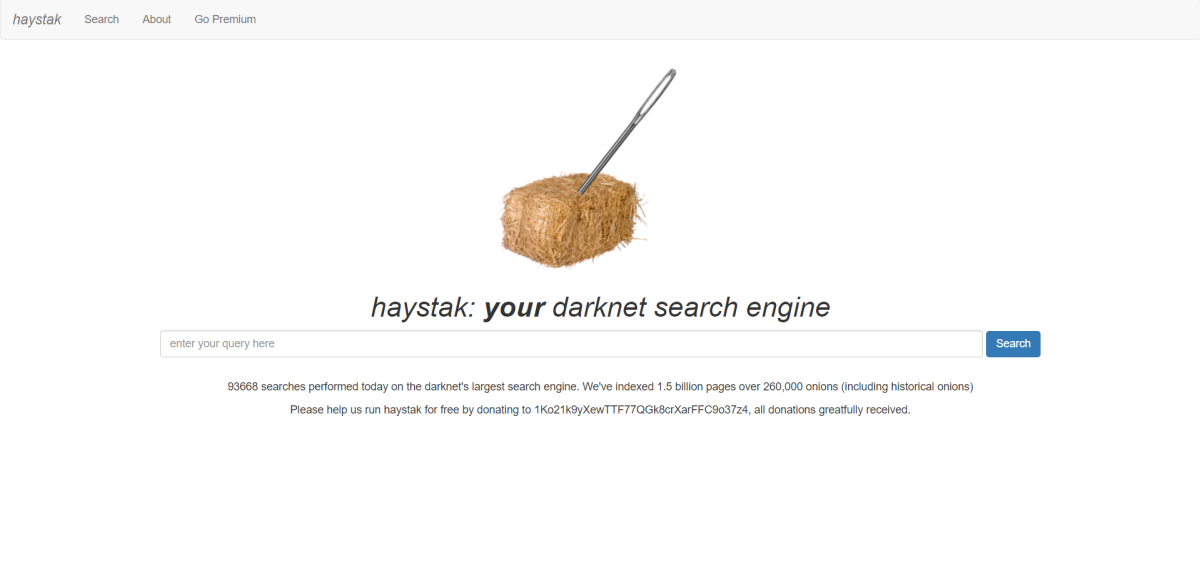
[Image Placeholder: Screenshot of the Haystak search engine homepage showing the search bar and safety filter toggle options.]
WHAT IS THE HAYSTAK SEARCH ENGINE?
Haystak is a dark web search engine designed specifically to index .onion hidden services. Built from the ground up to interact with the Tor network, it provides a familiar search bar interface. The platform indexes over a billion individual pages, making it one of the largest repositories of dark web URLs available publicly. It operates on a strict no-tracking policy, a core requirement for any tool within the privacy-focused Tor ecosystem.
IS HAYSTAK STILL WORKING IN 2026?
One of the most common questions users have is whether Haystak is currently active. As of 2026, yes, Haystak is still working, but like all dark web infrastructure, it experiences intermittent downtime.
Current status: The engine remains operational, but you may occasionally encounter connection timeouts. This is rarely a problem with your browser.
Why downtime happens: Hidden services are frequently targeted by DDoS attacks. Additionally, because the site relies on a single hosting infrastructure rather than distributed nodes, server maintenance can take the engine offline for days at a time. You can monitor general Tor network health to see if the issue is network-wide by checking platforms that track dark web network statistics.
How to verify official links: Never use random link directories if Haystak is down, as they often host phishing clones. Always verify the URL through trusted clearnet repositories like the Tor Project's official links page.
Alternatives when unavailable: If the main site is down, you can temporarily pivot to Ahmia or DuckDuckGo's .onion service until Haystak's servers are restored.
WHO SHOULD USE HAYSTAK?
Because the dark web carries inherent risks, the right search engine depends heavily on your technical experience and goals. Haystak is a powerful tool, but it is not universally the best starting point for everyone.
| User Type | Recommendation | Reasoning |
|---|---|---|
| Beginners | Ahmia first | Beginners should use moderated engines to avoid accidental exposure to illicit material or phishing clones. |
| Researchers | Haystak | OSINT professionals need the largest possible index to find niche, obscure, or newly created hidden services. |
| Journalists | Haystak + Ahmia | Journalists need Haystak's depth for source finding, but should cross-reference with Ahmia to verify link safety. |
| Privacy Enthusiasts | Haystak | Users looking for specific privacy tools, encryption guides, or secure forums benefit from Haystak's massive reach. |
| Casual Users | notEvil | Users just curious about the dark web should use strictly filtered engines to ensure a completely safe browsing experience. |
HOW HAYSTAK COMPARES TO OTHER DARK WEB SEARCH ENGINES
To understand where Haystak fits into the broader ecosystem, you have to look at the trade-offs. The dark web search ecosystem is generally split between volume and safety.
Haystak prioritizes raw volume. It crawls aggressively, meaning it finds more sites than almost anyone else, but it inevitably indexes lower-quality pages alongside legitimate resources. Ahmia and notEvil prioritize curation. They actively filter out bad content, resulting in a much smaller but significantly safer index. Torch represents the legacy "wild west" approach—large index, zero modern safety features. Finally, DuckDuckGo occupies a completely different category; it is a surface web engine accessed via Tor, meaning it searches the clearnet anonymously rather than searching the darknet.
A BRIEF HISTORY OF HAYSTAK
The exact origins and founding team of Haystak remain largely anonymous, which is standard practice for dark web infrastructure operators. However, its development history is well-documented within Open-Source Intelligence (OSINT) communities. Haystak emerged in the mid-to-late 2010s as a direct response to the limitations of legacy engines like Torch, which were heavily plagued by spam and outdated indexes. Built using Python-based web crawlers designed specifically to parse .onion protocols, Haystak quickly scaled its database by continuously following links across the Tor network [4]. Its development trajectory has focused less on public marketing and more on raw indexing power, leading to its current status as a multi-billion-page repository.
WHY FINDING DARK WEB SEARCH ENGINES IS DIFFICULT
Navigating hidden services presents unique challenges. Standard browsers cannot resolve .onion addresses, leading to immediate errors. Furthermore, the dark web evolves rapidly; links that worked months ago often go offline permanently. Users also misunderstand the system, expecting surface-web uptime from individual operators running limited infrastructure. Finally, Tor relies on volunteer-run nodes, making browsing inherently slower regardless of your search engine.
HOW THE HAYSTAK SEARCH ENGINE WORKS
Haystak relies on three components: crawlers, the index, and the interface. Its spiders operate entirely within the Tor network, requesting .onion pages to extract text and hyperlinks. When a spider finds a new link, it queues it for crawling. Once processed, the data is added to the index—a massive database mapping keywords to .onion URLs. Haystak stores only metadata and snippets, not the actual page content. When you enter a query, the engine scans this index, ranks results by relevance, and presents the links anonymously without logging your IP. [1]
KEY FEATURES OF HAYSTAK
| Feature | Description | User Benefit |
|---|---|---|
| Massive Index | Billion+ indexed .onion pages. | Higher chance of finding obscure forums. |
| No Tracking | Zero-logs; no IP or query storage. | Complete privacy aligning with Tor's philosophy. |
| Safety Filters | Optional parameters to exclude explicit content. | Curates a cleaner experience for researchers. |
| Tor-Native | Hosted exclusively as a .onion hidden service. | Fully encrypted connection between user and engine. |
HAYSTAK VS AHMIA
Because Ahmia is the most frequently compared alternative, it deserves a direct breakdown.
- Index Size: Haystak dwarfs Ahmia. If a hidden service exists, it is likely in Haystak. Ahmia only includes sites that pass moderation or are manually submitted.
- Moderation: Ahmia is heavily moderated and allows users to report illegal content. Haystak relies purely on automated filters that the user can toggle.
- Privacy: Both are excellent. Ahmia does not log queries, but Haystak’s purely Tor-native setup (no clearnet version) gives it a slight edge for hardcore privacy purists.
- Search Quality: Ahmia returns higher-quality, spam-free results. Haystak returns higher-quantity results, requiring the user to sift through dead links.
- Best Use Cases: Use Ahmia for safe, general exploration. Use Haystak when you are hunting for a highly specific, obscure .onion page. For safe setup, reading this official Ahmia verified access guide is highly recommended.
HAYSTAK VS TORCH
Torch is the oldest surviving dark web search engine, making it Haystak’s most direct historical rival.
- Search Coverage: Both have massive indexes, though Haystak’s is technically larger and more frequently updated.
- Spam Levels: This is Torch's biggest weakness. Torch is notorious for returning pages of cloned, spammy links. Haystak’s algorithm does a better job of pushing spam down in the rankings.
- Reliability: Torch has incredible longevity and rarely goes down. Haystak experiences more frequent intermittent downtime.
- User Experience: Torch looks like a website from 1998 and lacks modern features. Haystak offers a slightly more modern interface with working safety toggles.
HAYSTAK VS NOTEVIL
notEvil takes a completely different philosophical approach to indexing compared to Haystak.
- Curated vs Unfiltered: Haystak is an unfiltered firehose of .onion links. notEvil attempts to curate "ethical" content, actively rejecting illicit material at the crawler level.
- Safety: notEvil is inherently safer for casual browsing because of its strict filtering. Haystak requires the user to proactively enable safety filters.
- Index Size: Haystak wins by a landslide. notEvil’s strict curation means its index is a fraction of the size.
- Research Use Cases: Academic researchers and journalists prefer notEvil to avoid accidentally crossing legal or ethical lines. You can learn more about how notEvil handles content filtering to see if its philosophy matches your boundaries. Conversely, OSINT researchers prefer Haystak for comprehensive data gathering.
HAYSTAK SEARCH TIPS
Finding what you want on the dark web requires a different approach than using Google. Standard search tactics often fail here.
- Use Exact-Match Queries: The dark web is small. Searching "privacy forum" yields messy results. Searching "privacy forum" forces the engine to find that exact phrase.
- Master Filtering: Always toggle the safety filters on if you are doing general research. You can usually categorize by date or relevance to push older, dead links further down.
- Finding Forums: Add the word "board," "forum," or "chan" to your query.
- Finding Privacy Resources: Search for specific tool names rather than broad concepts. Search "Tails OS guide" rather than just "privacy."
HAYSTAK ONION URL VERIFICATION
Because search engines are high-value targets, phishing clones of Haystak are common.
Fake mirrors: Scammers create sites that look exactly like Haystak but are designed to capture your search queries or prompt you to download malware. Phishing sites: Never enter any personal information, passwords, or cryptocurrency keys into a search engine page. A search engine only needs a text query. How to verify official addresses: The only legitimate, official URL for the engine is: http://haystak5njsmn2hqkewecpaxetahtwhsbsa64jom2k22z5afxhnpxfid.onion/. Bookmark this exact string the first time you successfully connect. If you ever get a certificate warning or a different URL, close the tab immediately.
[Image Placeholder: Screenshot of the Tor Browser URL bar with the official Haystak .onion link entered, highlighting the secure connection and exact spelling.]
OTHER NOTABLE ALTERNATIVES (CLUSTER SECTION)
Beyond the direct comparisons, a few other tools serve specific niches in the dark web search ecosystem:
- DuckDuckGo Onion: Perfect for beginners who want private general searches. However, you may want to read a DuckDuckGo search engine review to see if it is actually good or overrated for dark web use, since it only searches the clearnet.
- DarkDuck: A niche engine that exclusively indexes privacy tools and security forums. It has an incredibly high signal-to-noise ratio if you are looking for encryption software.
HOW TO SAFELY ACCESS AND USE HAYSTAK
First: Foundation setup
Download the Tor Browser directly from the official Tor Project website. Connect a premium VPN before opening Tor to prevent your ISP from seeing your connection. [Internal Link: Best VPNs for Tor in 2026]
Next: Fix mistakes and habits
Set your Tor Browser security level to "Safest" (via the shield icon). This disables JavaScript, a primary attack vector used to de-anonymize users. Ensure your system firewall is active.
Finally: Improve system/tools/strategy
Navigate to the verified Haystak URL. Enable safety filters and use specific, quoted keywords to get usable results.
IS HAYSTAK LEGAL?
Yes, using the Haystak search engine is completely legal in most jurisdictions. A search engine is fundamentally a directory—it provides URLs, not the content hosted on those sites. Law enforcement agencies themselves use tools like Haystak to locate illicit hidden services. Illegal activity occurs based on your actions after you click a link (e.g., purchasing illegal goods, viewing explicit material). The mere act of querying a dark web index is not a crime.
COMMON PROBLEMS & FIXES
Problem: Clicking a result returns a "Connection Timed Out" error. Fix: Hidden services go offline frequently. Try again later or look for a cached version.
Problem: Haystak itself will not load. Fix: The Tor network is congested, or your entry node is down. Request a "New Circuit" from the Tor Browser menu.
Problem: Search results are filled with spam. Fix: Tighten queries using quotation marks and utilize Haystak’s built-in filtering options.
PRO TIPS
- Cross-reference engines: Haystak might miss a site that Ahmia indexed. Use two or three engines for comprehensive coverage.
- Never download files: Downloading executables from dark web links is the fastest way to infect your machine.
- Accept "Link Rot": A large percentage of dark web links are dead. Scan results quickly for active v3 addresses (56 characters long).
SAFETY & BEST PRACTICES
The dark web requires strict operational security. Never use your real name or log into personal accounts. Keep your Tor Browser updated. If you interact with communities you find through Haystak, learning what PGP is should be your next immediate step. PGP encryption is the standard for secure communication, and without it, your messages are unprotected. Remember that search engines only provide links; they do not verify destination safety. [Internal Link: Advanced Dark Web Security Practices]
RELATED GUIDES
- [Internal Link: Common Problems with Dark Web Search Engines and How to Fix Them]
- [Internal Link: Best Privacy Tools Found on the Tor Network in 2026]
- [Internal Link: Understanding Onion v3 Addresses and Why They Matter]
FAQ
Does Haystak track what I search for? No. It uses a strict no-tracking policy, meaning it does not log IP addresses, store queries, or use cookies.
Why are so many links on Haystak dead? Hidden services rely on individual operators. When a server shuts down, the site disappears, and search engines cannot keep up with this rapid turnover.
Can I access Haystak without the Tor Browser? No. It is hosted exclusively as a .onion hidden service, which standard browsers cannot resolve.
What happens if I click a bad link on Haystak? You could be exposed to phishing or de-anonymization scripts. This is why setting your Tor Browser to "Safest" to disable JavaScript is critical.
CONCLUSION
Finding information on the Tor network without a dedicated index is frustrating. The Haystak search engine solves this by providing a massive, no-tracking database of .onion links. While it has limitations—most notably dead links and occasional downtime—its sheer size makes it highly valuable for researchers and privacy enthusiasts. By understanding how it compares directly to curated alternatives, knowing who it is best suited for, and strictly following operational security practices, you can safely navigate the hidden web without compromising your identity.